How A Difficult Boss Can Affect Your Confidence And Mental Health

Updated: 2 days ago
I've worked with all sorts of people over the years.
Some have been loud, direct and capable of turning a fairly ordinary Tuesday morning meeting into something resembling a hostage negotiation. Others have been quieter and more considered. There have been people I've liked immediately, people I've taken a while to understand and probably a few who've taken their time to understand me.
For the most part, I've always found a way of making it work. You learn what makes somebody tick, they learn what makes you tick, you occasionally piss each other off and then you get on with whatever it is you're being paid to do.
Things changed for me a little while ago when I inherited a new line manager.
I found myself working for someone I genuinely disliked. I just couldn't take to him.
To be fair, I think the feeling was mutual.
My previous line manager leaving had been a big shock to us all. I admired her and she gave me the autonomy I needed to be effective in my role, so there was probably already some nervousness about who would replace her. Looking back, I think I'd formed an opinion of the new bloke before he'd even got his feet under the table.
I don't normally put much faith in first impressions. People have surprised me plenty of times over the years.
This one turned out to be remarkably efficient.
During those first few months, I tried to put my initial reaction to one side. He was clearly intelligent and he'd been around long enough to know a thing or two. The problem wasn't that he was stupid. If anything, that would have been easier to understand. He just seemed to have this extraordinary ability to walk into a room, tell everyone what was wrong and leave without anybody being entirely sure what we were supposed to do about it.
He also said Ay, caramba whenever somebody raised a problem.
Constantly.
I appreciate that's completely irrelevant to a serious reflection on workplace anxiety, but it really fucking annoyed me.
The important bit is who I was before all this, because I think that's what explains why everything that followed affected me as much as it did.
I'd been with the company for about three years and I loved my job. I had a brilliant team, good relationships with my peers and a role covering around 3,500 people. We'd delivered some genuinely good work and I'd built a decent reputation with people whose opinions I respected.
I've never been somebody who walks around thinking he's brilliant at what he does. I've had imposter syndrome. I've doubted myself. I've gone into new jobs nervous about the impact I'd have and wondering what I'd actually bring to the role.
But I'd reached a point in this particular job where I felt established. I knew my job, I knew the business and I knew the people.
For some reason, I found myself doing cartwheels to prove my worth all over again.
But only to one person.
At first it was little things. I'd call him on Teams and get buttoned, then discover he was happily chatting to somebody else a few minutes later. After a while I stopped calling. He'd ask me to develop a plan, I'd spend hours putting something together and he'd pull it apart. I'd take the feedback, try again and send him what he'd asked for, only to hear nothing. If I chased it, he was too busy to look at it.
One-to-ones were cancelled, shortened or spent talking about everything except how I was actually doing. There were even occasions when I'd sit there like a knobhead waiting for him, only for him not to turn up.
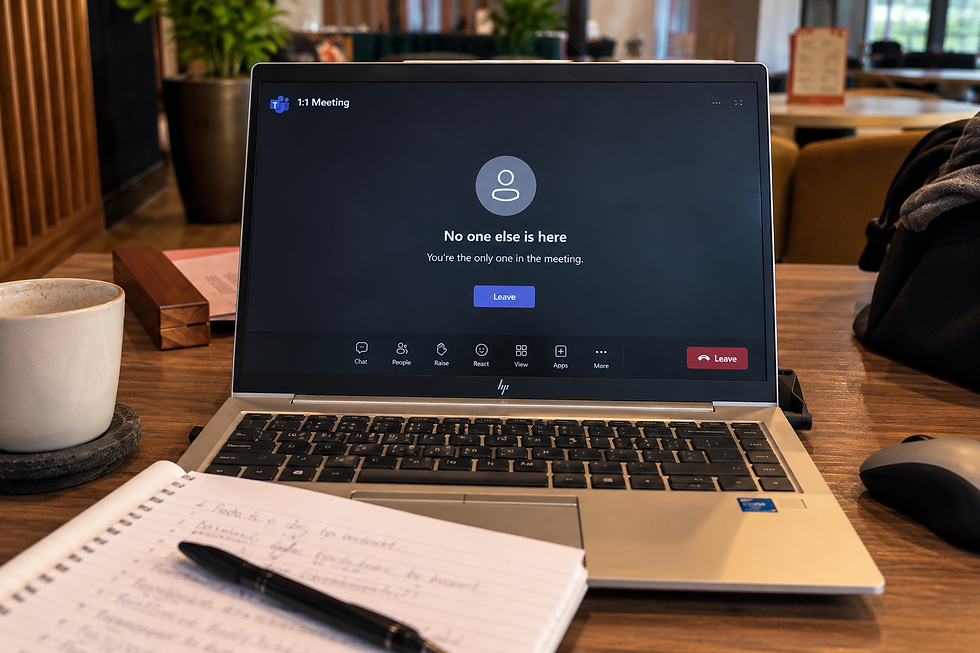
It wasn't just me either. People at my level and below were struggling. Some would find almost any excuse not to attend his meetings. Employee survey results became increasingly difficult to ignore, although somehow the lesson he took from them rarely seemed to involve looking in the mirror.
None of this was particularly dramatic. Nobody was throwing chairs around. There wasn't one enormous incident I can point to and say, There. That's when everything changed.
It was more like water getting into something.
A little bit at a time.
There was one example that probably captures the frustration better than anything else. I'd been working on a proposal around how we controlled work on our sites. It had started under the previous director and formed part of a much bigger programme.
There were changes to systems, clearer controls and some fairly straightforward ideas around the things that could seriously hurt people.
When the new director arrived, the work stalled. Other things were apparently more important. I understood that priorities changed, but I couldn't understand why something that seemed so obviously important to me suddenly wasn't.
Around twelve months later, a consultancy firm was brought in to complete a gap analysis.
And guess what they found.
The same gaps.
Even better, I'd shared much of my previous work with the consultants to help them understand what we'd already done. Some of that work then found its way back into the recommendations presented to the director and suddenly we had a fast-tracked plan to make the cultural changes we needed.
I remember sitting there thinking, for fuck's sake.
Looking back, though, the important part of that story isn't whether I was right and he was wrong.
It's how much things like that had started to matter to me.
Another thing that hit me harder than I expected was a change in my job title. Technically it was a downgrade, although my salary stayed the same.
My workload, funnily enough, went the other way.
I inherited another large part of the business, took on a much bigger team and suddenly had considerably more senior relationships to manage. Strangely enough, I actually enjoyed the additional responsibility. Some of the people I worked with were brilliant and genuinely supportive of the changes we were trying to make.
That's the strange contradiction when I look back.
So many things were going well.
Yet one person's opinion of me was occupying an enormous amount of space in my head.
And I'll admit that I started taking everything personally.
A cancelled meeting wasn't just a cancelled meeting anymore. An unanswered message meant something. A criticism stayed with me. An idea being dismissed became evidence of something bigger.
I was becoming angry and, if I'm being fair to the people who had to listen to me at the time, probably a bit of a vindictive little shit.
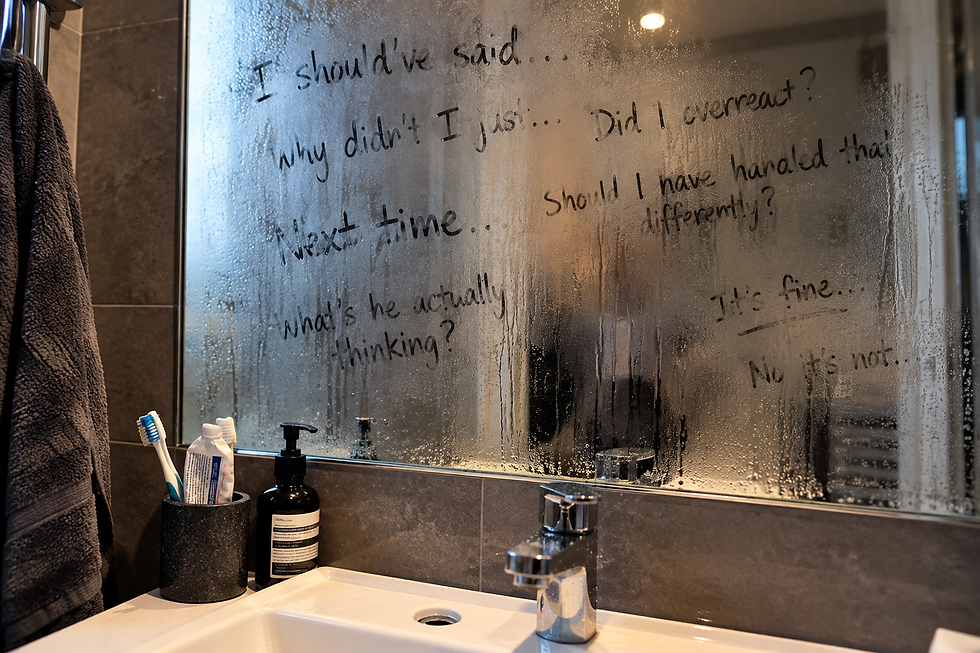
Any opportunity to explain how unfair the situation was, I took it.
And then I started taking it home.
The thing I remember most is sitting in front of the television with absolutely no idea what I was watching because my brain was somewhere else. I'd be replaying an interaction from earlier in the day or preparing myself for whatever ambush I thought might be waiting for me tomorrow.
I wasn't just remembering these conversations either.
I was editing them.
Why did he say that? What did he mean by it? I should have said this. Next time he says that, I'll say this.
In my head, obviously, I was magnificent. Calm, articulate and absolutely devastating. I'd construct entire speeches where I dismantled every argument he'd ever made and everyone in the room went silent while quietly reconsidering everything they'd ever believed.
That's probably the best way I can describe what work anxiety started to feel like for me.
I'd left the building, but I hadn't really left work.
A five-minute conversation at two in the afternoon could still be happening in my kitchen six hours later. I'd wake up thinking about things and go to bed doing the same, and because I couldn't understand why this relationship wasn't working, I became increasingly determined to solve it.
Eventually I adopted a different approach.
Fuck him. If he doesn't value what I'm doing, I'll do it anyway.
At the time, that felt quite empowering.
Looking back, it wasn't particularly healthy leadership.
I created a bubble around myself and my team. I shielded them from much of what was coming down because I'd convinced myself I knew best. We did some genuinely good work inside that bubble, but in trying to protect my people from what I considered to be bullshit, I'd effectively separated my wolves from the pack.
That's uncomfortable to admit.
But it's probably one of the most useful things I learned from the whole experience.
I wasn't just reacting to poor leadership anymore. I was allowing that reaction to affect the way I led other people.
Somewhere along the way, without really recognising it, the thing I was trying to fix stopped being the job.
It became me.
I started doubting my ability to do a job I simultaneously knew I was doing well.
There's one of those contradictions I seem to write about quite a lot.
And if I'm being completely fair to myself and everyone else involved, there were probably decisions I made during that period that weren't entirely driven by what was best for everyone. There was definitely a bit of I'll fucking show him creeping into my thinking.
I didn't suddenly stop functioning or become incapable of doing my job. It was subtler than that. I wasn't sleeping particularly well. I was angry more often. A perfectly decent day could be ruined by one interaction, and then I'd allow that interaction to follow me through the front door.
You can have twenty people telling you you're doing a good job and still spend your evening thinking about the one person who doesn't.
Maybe that's ego. Maybe it's insecurity. Maybe it's people pleasing.
Maybe it's just being human.
For me, I think it was mostly a need to understand something that I couldn't make sense of.
Eventually, someone who worked for me pointed this out. I kept trying to rationalise something that, from where I was standing, felt fundamentally unfair. I was treating it like a problem that could be solved if I just thought about it for long enough.
Perhaps there wasn't an explanation. Perhaps there wasn't a conversation I could have that would suddenly make everything click into place. I might simply never understand it.
For someone who can happily think about the same thing for six weeks looking for an answer, this was deeply inconvenient information.
Things eventually came to a head at my end-of-year review.
I walked into that meeting genuinely believing I'd had my strongest year since joining the company. I'd managed the biggest team I'd ever had, our employee survey results were 100%, we'd delivered a huge amount of work and I'd taken on considerably more responsibility.
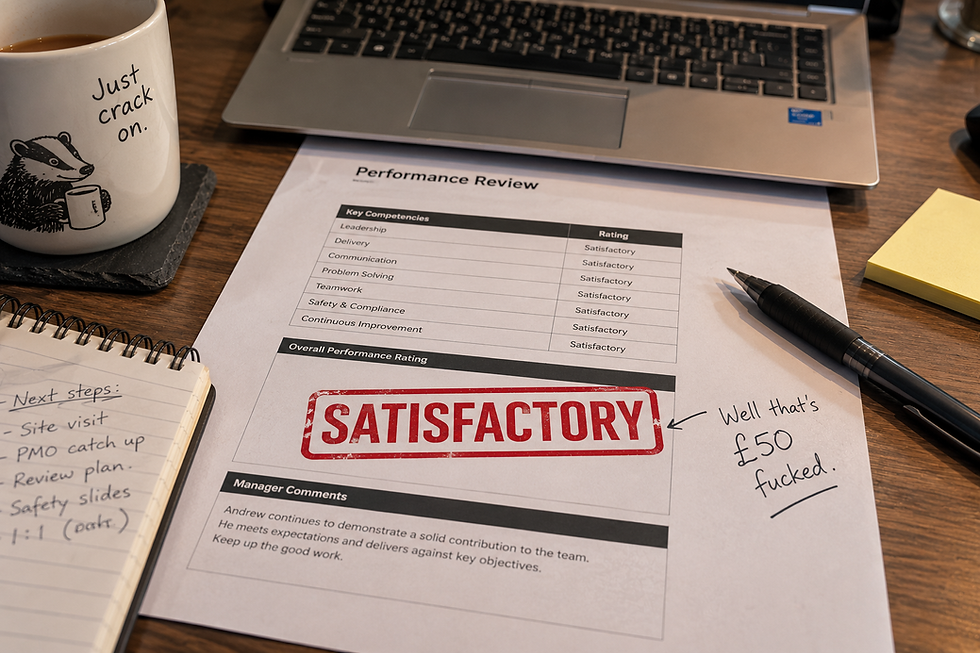
I wasn't expecting a parade through the car park.
But I thought I'd done well.
I came out with a rating of satisfactory.
Or well placed.
Or some other wonderfully corporate collection of words that essentially meant not as good as you thought you were.
I argued my case. He wasn't moving.
The ridiculous thing was that the financial difference was practically nothing. About fifty quid a year or something equally life-changing.
It wasn't about the money.
By then, that rating had become a verdict on something much bigger.
I'd spent years working with difficult people. People who challenged me, disagreed with me and sometimes thought my ideas were shit. I'd handled all of that.
Yet somehow this particular man had got under my skin in a way they never had.
A person whose leadership I didn't respect and whose approval I shouldn't really have needed had ended up with an extraordinary amount of influence over how I felt about myself.
That should probably have concerned me more than the performance rating did.
I remember thinking, fuck this.
Not dramatically. Not triumphantly.
I'd just had enough.
I moved into another part of the business and thought leaving would be the end of it.
It wasn't.
Because although I'd left him behind, I'd taken some of what had happened with me.
My confidence was shot.
Again, not in some dramatic way where I suddenly couldn't function. I just wasn't quite myself anymore.
I moved into another role with some genuinely lovely people, several of whom I'd known for years, and I think they could see it. I'd second-guess things I wouldn't previously have thought twice about. I'd hesitate where I'd once have trusted myself. Something could be perfectly good and I'd still wonder whether it was good enough.
It took me much longer than I realised to get some of that confidence back.
I did it, strangely enough, by pushing myself outside my comfort zone in a part of the business I knew fuck all about.
Somewhere around Christmas, I remember someone sending me a message saying they'd noticed a difference in me. They weren't used to Scousers being this quiet.
I can't remember exactly when they sent it.
But they noticed.
That's the bit I remember.
It was around this time that I started reading more, drawing and eventually writing.
There wasn't some grand plan to rediscover myself through creativity. I wasn't sitting there thinking this was the beginning of a profound personal journey.
I just found that it made my head quieter.
So I kept doing it.
Eventually I started putting some of that writing online, which was terrifying in a completely different and considerably more enjoyable way.
Something was changing at work too.
I started taking a few things on, then a few more. People trusted me with things and, gradually, I started trusting myself again.
I was presenting confidently. I was producing work around strategy, leadership and culture and people seemed to connect with it. I could sit in a room with senior people and contribute without mentally reviewing every sentence before I said it.
Ironically, one of the leadership pieces I developed during this period was based around a fairly straightforward principle:
No dickheads.
The irony wasn't lost on me.
But there wasn't one big moment where my confidence suddenly returned. Nobody tapped me on the shoulder and told me it had been reinstated.
I just started recognising myself again.
That's how I think confidence often comes back.
Quietly.
You notice one day that you've made a decision without questioning yourself six times. You speak in a meeting without rehearsing the sentence first. Somebody disagrees with you and you don't spend the drive home wondering whether it means you're shit at your job.
Eventually, you realise you haven't thought about whether you're good enough for a while.
I'm in a very different place now. I'm still learning and I still get things wrong, but I'm no longer terrified of the backlash from a misinterpreted email.
These days I'm more likely to lose sleep because the image on one of my articles is three millimetres too far to the left.
Progress comes in many forms.
I feel quite content at work now. I feel useful and, more importantly, I trust my own judgement again.
Not because everybody suddenly thinks I'm wonderful.
They don't.
And that's actually quite important.
What changed was that I stopped using one person's reaction to me as the measurement of who I was.
Getting some distance from that period gave me the opportunity to see something else too.
For a long time, I thought this story was about a bad director.
It isn't really.
It's about how easily another person's opinion can become your own.
I suspect somebody reading this will recognise that feeling, even if the circumstances are completely different.
Maybe it's the email you received at three o'clock that you're still thinking about while you're making dinner. Maybe it's something your manager said in a meeting that you've replayed so many times you're no longer entirely sure what was actually said.
Maybe somebody else got the opportunity you wanted and your first instinct wasn't to wonder why they got it, but to start listing all the things that might be wrong with you.
Maybe you're checking Teams when nobody has asked you to, or lying in bed rehearsing a conversation that hasn't happened yet.
That's the bit I recognise now.
It's not simply worrying about work.
It's gradually becoming so focused on how somebody else sees you that you stop noticing what you see when you look at yourself.
And sometimes there genuinely is something for us to learn from that discomfort. I don't want to turn every difficult boss into a villain or every uncomfortable conversation into evidence of a toxic workplace.
Sometimes criticism is fair. Sometimes our work isn't good enough.
Sometimes we're the difficult person in somebody else's story.
Being willing to consider that matters.
But there's another question worth asking too.
I spent a long time asking myself, what's wrong with me?
It took me much longer to ask, what is this environment doing to me?
They're not the same question.
With distance, I can see my own responsibility in all of this much more clearly as well.
He was responsible for the way he led, but I was responsible for what I did with it.
I was the one taking him home.
Not literally.
I'd have buried him.
What I mean is that I gave him space in parts of my life where he had absolutely no business being. I put him into conversations he wasn't part of, replayed meetings that had already finished and turned unanswered emails into judgements about my competence.
Worst of all, I kept trying to earn validation from somebody I didn't particularly like and perhaps was never going to give it to me anyway.
There's something faintly ridiculous about that when I look back. I didn't respect his leadership, I didn't particularly value his opinion and I couldn't wait to get away from him.
Yet somehow I'd made his opinion of me incredibly important.
That's the part I think about now.
Because none of this excuses poor leadership, and it certainly doesn't mean people should toughen up and tolerate shitty workplaces.
It means recognising what something is costing you before the cost becomes normal.
Work will quite happily take forty hours of your week. For many of us, it will take considerably more.
But it doesn't automatically get Tuesday evening as well.
It doesn't get the drive home, dinner with your family and two o'clock in the morning because somebody said something in a meeting that you're still trying to decipher.
And it certainly doesn't get to decide what you think about yourself.
I know that now.
I didn't then.
The strangest thing is that I can't remember most of what I spent all those evenings worrying about. The emails have disappeared, the meetings have gone and I've completely forgotten most of the magnificent speeches I prepared while brushing my teeth.
But I remember what it felt like to become a smaller version of myself trying to win the approval of somebody I didn't even like.
Maybe that's the bit worth remembering.
Anxiety doesn't always mean you're incapable of coping.
Sometimes you've become so good at coping that you haven't stopped to ask whether you should still have to.
And sometimes the person you need to stop taking home with you isn't sitting beside you at all.
They're still at work.
Leave them there.
They've already had forty hours of your week. The greedy little fucker isn't getting Friday night as well.
Before you disappear...
If you enjoyed this, there’s plenty more where it came from. You can subscribe at the top of the page and get new stories straight to your inbox. No spam, just a little more Wildly Gentle.


Comments