I Knew What Gambling Could Cost. I Did It Anyway.

Updated: 2 days ago
My dad used to say I was so tight I could peel an orange in my pocket.
He particularly enjoyed telling people this when it was my round in the pub. There I’d be, perfectly happy with my blackcurrant and soda water, while he announced to everyone within earshot that his son was tighter than a duck’s arse. To be fair, he probably had a point. I’ve always liked having savings, hated owing people money and felt considerably more comfortable knowing there was something left in the bank. In Dad’s version of events, his being skint and my being skint were two very different things. Apparently, mine meant being down to my last twenty grand. It wasn't, but he liked to exaggerate a tad from time to time.
Dad had a rather different relationship with money. On a Saturday afternoon, I could usually find him in Ladbrokes, William Hill, Coral or the pub, watching the racing with a collection of betting slips spread across the table. He loved the horses, enjoyed a night at the casino and, when we were kids, even owned a greyhound. As long as he had enough for a pint, he seemed happy enough.
The greyhound was called Innocent Paddy, and it was a fucking nightmare. If it rained the night before a race, Dad always fancied its chances because it ran better in the mud. Thirty-five years later, I still remember him telling us that. What I remember even more clearly is that the thing constantly escaped. Being a greyhound, it had a considerable advantage over a collection of kids running round the estate like dickheads, shouting its name. Eventually, someone would find it, usually in somebody’s bins, and we’d march it home by the collar.
Every Friday night we’d go to the dog track, where Dad wandered round in a white lab coat as though he was a professional fucking dog owner. I’d be stuffing my face with sweets. He usually let me take a mate, so as far as I was concerned, it was a brilliant night out.
We also spent a fair amount of time sitting outside bookmakers with a ten-pence mix while he placed his bets. Mum would quiz us when we got home, but she hardly needed witnesses. Dad never smoked, yet he’d come back stinking of cigarettes. In those days, the whole shop was a haze of grey smoke. His clothes gave him away before we’d opened our mouths.
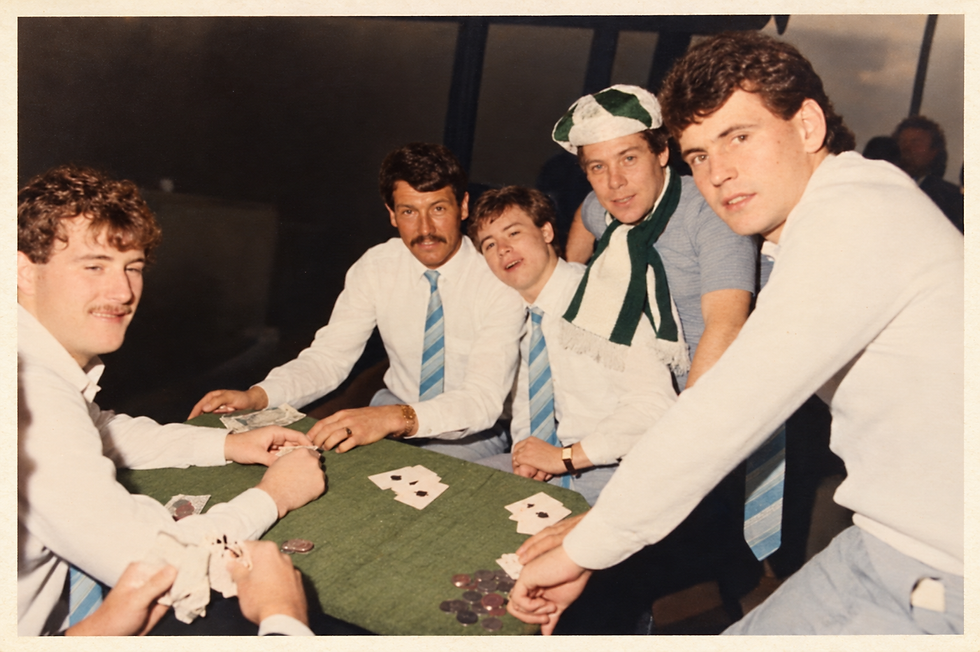
That was my introduction to gambling. I didn’t understand odds or stakes. I understood jelly babies, nights at the track and the possibility of a treat if Dad won. There were things I’d come to dislike about it as I got older, but at that age I had plenty of reasons to enjoy going with him.
His generosity continued long after I’d outgrown a ten-pence mix. He called it a dropsy: if he’d had a good day, he’d often slip you a few quid without being asked. Once, he phoned and asked whether he could borrow £300 because he was skint. I said it wasn’t a problem and asked when he needed it, at which point he started laughing. He’d actually won on the horses and wanted to give me £300. Apparently, if I’d refused to lend him the money, I wouldn’t have got the dropsy.
Tit.
I’ve watched him walk out of betting shops with more money than I’d earn in a month, grinning like the Grinch. Those wins made good stories, particularly when you were on the receiving end. It took me longer to understand what happened on the days when there was nothing to share.
Until I was about ten, we lived in a nice little house on a quiet cul-de-sac. Nothing extraordinary, but it was home. I remember being told several times that we were going to move, then being told we weren’t. Once, Mum said we were moving closer to her mum’s and I sobbed. A few days later, we were staying put, and I was delighted. I didn’t understand what was changing behind the scenes. I just knew I didn’t want to leave.
Eventually, my mum and dad ran into financial difficulties and we lost the house. I don’t know the full circumstances, and I wouldn’t pretend gambling was the only reason, but I know it played a part.
We moved to Domville, and I don’t want to make that sound like the end of a happy childhood, because I loved living there. The house was a tiny shithole from what I remember, but the lads I became closest to lived on and around that estate. We played football, got into mischief and had a great time. The address meant much less to me than whether my mates were coming out.
What I didn’t enjoy was some of the kids I’d been mates with before the move finding out why we’d left. Their big-mouthed parents had apparently supplied the details, and soon they were laughing and shouting that we’d been repossessed. I didn’t even know what repossessed meant. I just knew we’d moved house and that, for some reason, it was now something they could take the piss out of me for. It went on for weeks.
There were things happening at home that I understood just as little. Mum hid money so Dad couldn’t find it, and there were arguments about it. Some of the background I’ve only learnt from talking to her as an adult. She’s told me about money they’d saved for a week in a caravan disappearing when Dad got the gambling bug, and the holiday becoming a budget camping trip instead. As kids, we hadn’t known what had happened. We were going camping. Mum knew what we’d been saving for and why we couldn’t afford it anymore.

Dad hid money too, although he wasn’t particularly imaginative about it. He’d come home pissed after we’d gone to bed, tuck his winnings into VHS cases or ornaments and sometimes forget he’d done it. You’d go to put a film on and discover a few hundred quid inside Home Alone 2. Before the tape was out, you’d mentally spent it in the Toys “R” Us catalogue.
Unfortunately, Mum had an extraordinary ear for the sound of twenty-pound notes landing on a carpet. She’d swoop, and our newly discovered fortune would become food or money for the bills. Watching Dad frantically search for Home Alone afterwards, knowing full well he’d been rumbled, was quite entertaining. Looking back, I understand why she was so good at finding money. She’d spent years needing to know where it was.
There are things about being skint that we still laugh about. The cupboards were often full of Kwik Save’s finest No Frills offerings, which, if you grew up in the eighties or nineties, you’ll remember weren’t particularly concerned with attractive packaging. Things got interesting when the labels came off the tins and nobody knew what we were having for tea. Beans and peaches, anyone? I did love those little frozen pizzas that came in sleeves, though.
The funny memories are real. So were the bills Mum had to pay. I can love my childhood without pretending she was having as much fun trying to make the money stretch as we were finding it in a video case.
By the time I started earning, I’d seen enough to want to handle money differently. I tried to save and wasn’t interested in gambling. For a long time, I took that as evidence that I was unlikely to follow Dad into a betting shop or casino and get carried away. Whatever he said about my last twenty grand, though, there were times when money really was tight.
One of them came in my early twenties, when I lost my job a week before Christmas.
I was working as a tradesman, and the mortgage already took a fair chunk of what I earned, and there wasn’t much left to put aside. One morning, I was told there wasn’t enough work to keep me on over Christmas, although they did want me to finish the jobs I was working on before leaving at the end of the week.
I politely declined. Well, actually, I told them to fuck off, got in my van and drove home, via the scrapyard.
I’d accumulated a fair amount of lead in the back of the van that would ordinarily have ended up in the company’s skip. That morning, it earned me about £400. I’d love to tell you every bit of it was legitimately mine to take, but I’d be talking shite. It wasn’t my finest moment, and it didn’t leave me feeling much better. Four hundred quid was pretty much everything we had to get us through Christmas.
I phoned Dad and explained what had happened. He said he’d speak to someone at the oil refinery where he was working and see whether he could get me a start. It probably wouldn’t happen until after Christmas, but he’d do what he could. Meanwhile, I spent the next few days looking through the local paper and trying to pick up private work. There weren’t many people desperate to have their houses worked on a few days before Christmas.
Then Friday came and Dad phoned again. He was heading into Liverpool for a night at the casino and wanted me to go with him. He knew I’d had a dreadful week and thought getting me out of the house might help. When I told him I couldn’t afford it, he said he’d had a decent win on the horses and used a phrase I’d heard a thousand times growing up.
“Don’t worry, I’ll look after you.”
And he meant it. Whatever problems Dad had with money, if he had some and thought you needed help, he would help. Looking back, taking your financially struggling son to a casino was a questionable way of cheering him up. But it was somewhere Dad enjoyed himself, and he wanted to give me a good night.
My girlfriend went fucking nuts, which was understandable. She was worrying about the bills and Christmas while I was preparing for an evening on the roulette tables. My head was battered and I wanted to get out, so I went.
When we arrived, Dad gave me £30. I exchanged it for chips, wandered over to a roulette table and had an absolute blinder. I can still remember some of the numbers I played: zero, fourteen, twenty-three and thirty-two. Every time that little white ball landed somewhere favourable, another pile of chips came sliding towards me.
Whenever the croupier paid me with a pony, a £25 chip, I put it straight into my back pocket. Anything smaller went back on the table. Within an hour, I had more than a thousand pounds stuffed into my trousers. I walked out with about £1,200, having arrived wondering how I was going to afford Christmas dinner.
Dad made me give him his £30 back when he realised how much I’d won. We went for something to eat afterwards, Uncle Sam’s if I remember correctly, and I paid for the food. Generous of me, I thought, considering I’d just handed him back his thirty quid.
My girlfriend was still fuming when I got home, until I started emptying my pockets and counting the money on the living room floor. Before long, it had been allocated to Christmas dinner, presents and things for the house. We could enjoy Christmas instead of worrying about how to pay for it, and I felt an enormous sense of relief.
That relief mattered. I’d lost my job and spent the week worrying about Christmas. Now the money was there, and all I’d done was spend an evening with Dad watching a ball go round a wheel. I knew gambling could empty a house of money. I’d just watched it fill ours with enough to stop worrying for a while.
I wanted to feel that again.
Once I was back in work and earning decent money, gambling became a regular part of going out with my mates. We’d visit the casino before a night in Liverpool, sometimes afterwards, and occasionally both. Usually, we’d win a little, lose a little and head into town. If someone did particularly well, the winnings might pay for the drinks.
One of my best mates had a brother who was a fairly well-known jockey, so we spent time at the races too. Occasionally, he got us owners’ and trainers’ passes. There we’d be in our Next suits, trying to blend in with people wearing top hats and tails. I don’t think we fooled anyone. On one Derby Day, his brother gave him a tip about his chances, we all backed the horse, and it won. We spent the rest of the day celebrating.

Those were brilliant times. Between the casino, the races and nights out with my mates, there was plenty to enjoy, and gambling was mixed up in all of it. A losing bet didn’t seem particularly important when the day itself had been so good.
Somewhere along the way, I started expecting it to pay for the night out too. A couple of wins would cover the drinks; one decent spin would put me ahead. And when I lost, I sometimes became more interested in getting the money back than in whatever we’d actually gone out to do.
There’s one evening in Liverpool I remember particularly clearly. We’d gone to the casino before heading into town, and I had £100 for the night. I lost it on the roulette table in about two minutes. Rather than accept that I’d just made the evening considerably more expensive, I went to the cash machine and withdrew another £100. I wasn’t trying to win enough for Christmas this time. I just wanted to get back to where I’d been a few minutes earlier.
That hundred went too, so I withdrew more. With each visit to the cash machine, the amount I needed to win back grew, and walking away became harder to contemplate. I kept thinking my luck was about to change. Every spin offered the possibility of leaving without having to admit how much I’d lost.
It wasn’t enjoyable anymore. I’d arrived looking forward to a night with my mates, and now I was standing at a roulette table getting increasingly angry because a little white ball wasn’t landing where I wanted it to. Eventually, I emptied my current account and pulled out my credit card.
I’d always hated owing money. Yet there I was, borrowing it to carry on doing the thing that had just emptied my bank account. At the time, I could justify it: if I stopped, the money was gone; if I kept playing, there was still a chance I could get it back. Every withdrawal made the situation worse, but I kept treating the next one as the solution.
By the time I stopped, I’d lost more than £1,000 in about an hour. Roughly £750 of it was on the credit card.
As we were leaving, my girlfriend threw £200 at me. She’d won it earlier but deliberately kept it away from me because she knew what would happen if I got my hands on it. We still went out that night, although I don’t remember enjoying much of it. What I remember is waking up with a dreadful hangover and the horrible feeling of having done something I couldn’t undo.
I lay there thinking about the money and the debt. Then I started working out how I might win it back. Even with the previous evening sitting heavily in my stomach, I was considering going back to the thing that had caused it.
That bothers me more than any individual withdrawal. I was away from the table, with time to think and every reason to stop, and I was still finding reasons to go back. I couldn’t blame Dad or my mates for the money I’d spent. But calling myself a fucking idiot hadn’t stopped me wanting another go either.
It took a few months to clear the card, and I stayed away from casinos for a long time afterwards. I’d like to finish that part of the story by saying I learnt my lesson and never gambled again. It would make for a much tidier article, but it wouldn’t be true.
I’ve had the occasional flutter over the years. There have been times when I’ve been bored and thought, fuck it, I’ll put twenty quid in a fruit machine. Sometimes I’ve won, sometimes I’ve lost, and sometimes I’ve recognised the familiar irritation when the money disappears. Along with it comes the temptation to put a little more in, because surely something is about to pay out.
I’d rather be telling you about a younger version of myself I no longer recognise. Unfortunately, I know exactly what he sounds like. He’s the one explaining that another twenty quid isn’t much, that he’ll stop after this go, that it would be annoying to walk away just before it pays out. Being sensible with money the rest of the week doesn’t make him right.
Recognising that has made me less certain of the judgements I used to make about Dad. I’d wondered why he kept risking money when he knew what losing it would mean. Then I’d stood in a casino convinced that one more bet might spare me from the consequences of the last one. Our experiences weren’t identical, but I understood something I hadn’t understood before.
I’m not claiming that one disastrous evening tells me everything about addiction, or that paying off a credit card amounts to a recovery story. What stays with me is that I wasn’t enjoying myself and still didn’t want to stop. I could see the damage, but every pound I lost became another pound I needed to win back. From the outside, I’d thought the consequences should be enough to put someone off. At that table, I used them as a reason to continue.
Even now, I can tell you which numbers I played on a roulette wheel more than twenty years ago, but I couldn’t add up all the twenties and fifties I lost afterwards. I remember the £1,200, the meal with Dad and the money on the living room floor. Most of the losses never became stories. They were just money that wasn’t there anymore.
Writing this has meant looking at both, including the parts of Dad’s life that are difficult to put alongside the man I miss. He died without ever really losing his enthusiasm for the horses. I don’t know whether he would have described himself as having a gambling addiction, and I wouldn’t want his whole life reduced to it. He was funny, generous and loving. He also gambled in ways that hurt the people around him. Loving him doesn’t make that less true, and saying it doesn’t mean I love him any less.
I still treasure the evening he took me out after I lost my job. He wanted to help, and the money I won did help that Christmas. The trouble came when I started expecting other nights to end the same way. I remembered the relief of counting the money on the floor much more readily than I remembered Mum looking for enough to pay the bills.
There is another connection I hadn’t properly made until I wrote all of this down. When I was a child, Mum hid money because she was worried about what would happen if Dad found it. Years later, my girlfriend stood in a casino keeping her winnings away from me for exactly the same reason.

Two women, years apart, keeping money out of reach of someone they loved. I’d spent so long thinking about the differences between Dad and me that I’d missed how familiar that moment might have looked from the other side. I could pay off the credit card, and I did. It didn’t change the fact that someone who loved me had felt the need to protect her money from me.
If there’s anything I want someone to recognise in this story, it’s that moment before the next deposit or the next trip to the cash machine, when you’re trying to persuade yourself that another bet will fix what the last one has cost. I know how reasonable it can sound in your own head. I also know that being ashamed afterwards didn’t stop me wanting to do it again. If you recognise it too, you don’t have to wait for a bigger loss before telling someone what’s happening or asking for help.
Dad was probably right about the orange. I am careful with money. I also know what it’s like to stand at a roulette table with an empty bank account and a credit card in my hand, convinced the next spin will put everything right. Both things are true about me, and paying off the debt didn’t make the second one disappear.
Before you disappear…
If you enjoyed this, there’s plenty more where it came from. You can subscribe at the top of the page and get new stories straight to your inbox. No spam, just a little more Wildly Gentle.


Great read Andrew. As you are aware I can completely relate to this
Thank you for sharing this story, looking forward to reading your next one
Great read this mate. Been there a few times myself!
What a legend your old man was 💙
Oh my goodness haha I can laugh now … there was nothing stranger than defrosting money that you had hid in the beef burger box in the freezer😱and he still managed to find it 😂😂😂😂😂 what a loon🙏🏼